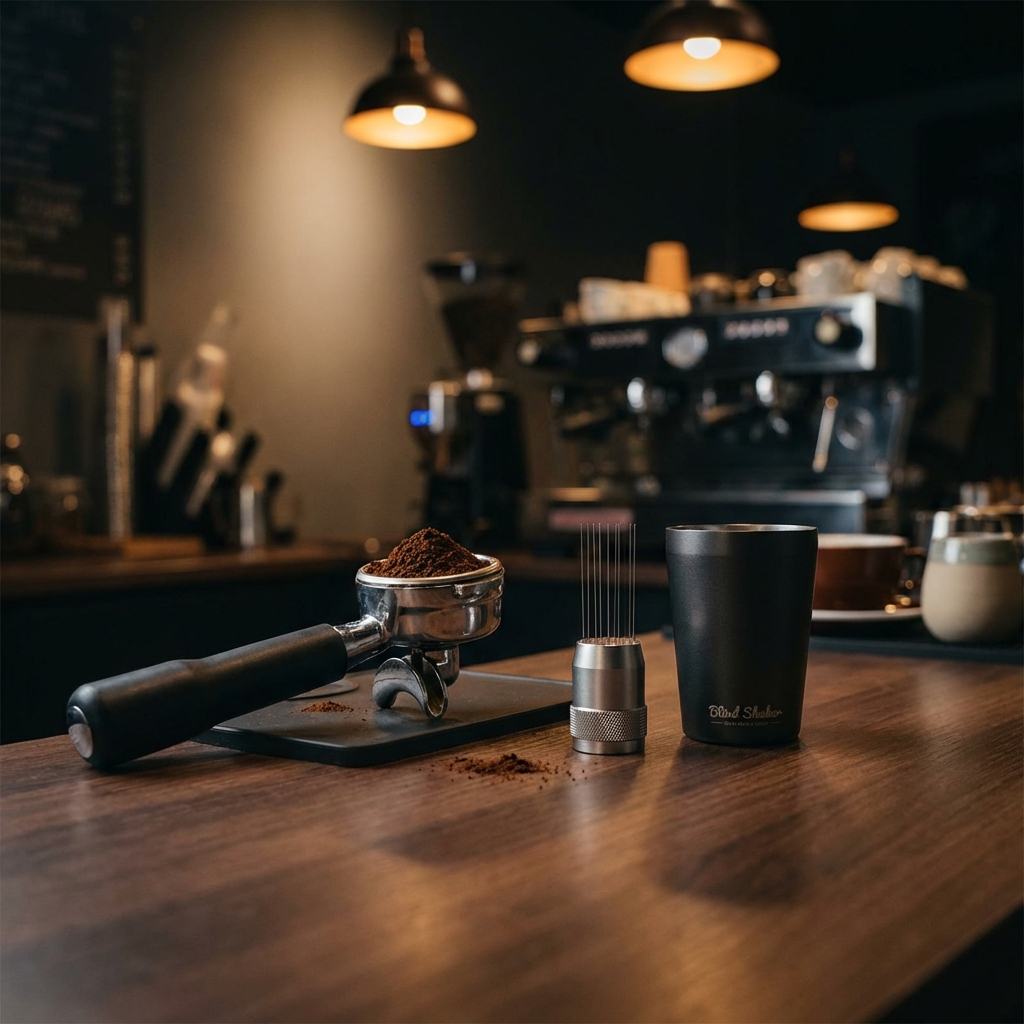
Puck preparation is the ritual every home barista obsesses over. For years, "raking" with needles (WDT) was the undisputed king. But thanks to recent data and viral debates, "shaking" has made a massive comeback.
Contender 1: The WDT (Weiss Distribution Technique)
The Method: Using thin needles (0.3-0.4mm) to rake through the coffee grounds in the basket.
The Logic: Grinders naturally produce clumps. Clumps cause channeling. WDT mechanically breaks up these clumps and fluffs the coffee bed for perfectly even density.
- Pros: Cheap ($10-15 tools work great), visually satisfying, proven consistency.
- Cons: Slower workflow, risk of scratching baskets if needles are sharp.
Contender 2: The Blind Shaker
The Method: Grinding into a cup with a lid, shaking it vigorously, and then dropping the grounds into the portafilter via a bottom release mechanism.
The Logic: Homogenization. Grinders output particles of different sizes at different times. Shaking mixes all particle sizes—fines and boulders—uniformly.
- Pros: Extremely fast workflow, keeps the station clean.
- Cons: Expensive (Weber version is $80+), requires a specific shaking technique.
The Data: What Happened?
Data from coffee experts like Lance Hedrick suggested that shaking actually produces higher extraction yields than WDT. Shaking effectively separates fines from boulders and redistributes them more evenly.
The Verdict
For Consistency: WDT is safer. It smooths out errors and guarantees a clump-free bed.
For Peak Performance: The Blind Shaker has the higher ceiling. If you nail the technique, you can get higher, sweeter extractions.
Can You Do Both?
Actually... no. Shaking creates a specific density structure. If you shake and then WDT, you undo the homogenization work. Pick one lane and stick to it!