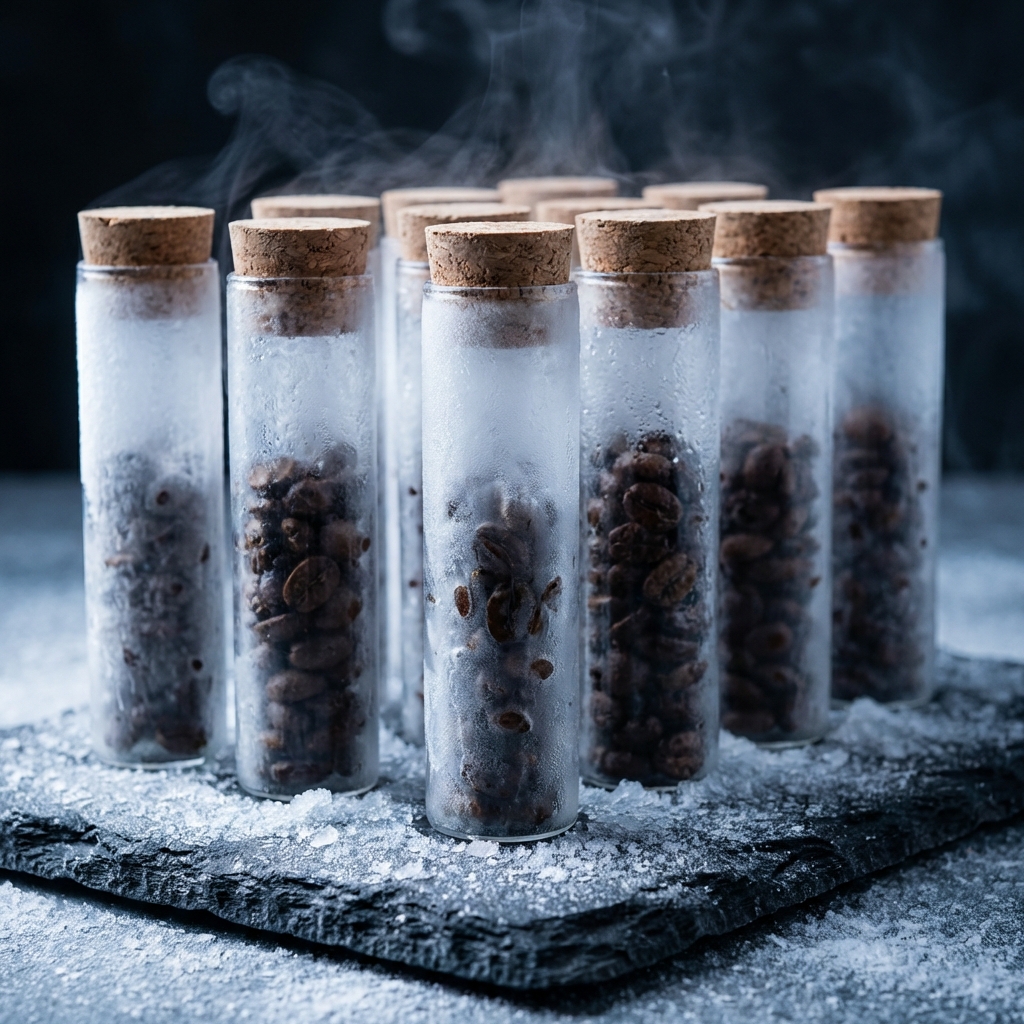
Old wisdom said "never freeze your coffee." New science says "you're crazy if you don't." If you buy expensive specialty coffee, the freezer is the only way to lock in that peak flavor for months.
Why Coffee Goes Stale
Staling is primarily oxidation. Volatile aromatic compounds escape the bean, and oxygen enters. This process accelerates with:
- Heat
- Light
- Oxygen exposure
- Moisture
The Science of Freezing
According to the Arrhenius equation, for every 10°C decrease in temperature, chemical reaction rates are cut in half.
By freezing coffee at -20°C, you essentially pause time. A bag of coffee that would go stale in 4 weeks on the counter can taste fresh for 18 months in the freezer.
Grinding Frozen Beans: A Hidden Benefit
Freezing does more than preserve; it improves grinding. Cold beans are more brittle. When they hit the burrs, they shatter more uniformly.
Studies confirm that grinding frozen beans produces a tighter particle distribution. This leads to higher uniformity and often sweeter extractions.
Do Not Thaw!
You do NOT need to thaw the beans before grinding. In fact, you shouldn't.
The mistake people make is taking a whole bag out, opening it (letting condensation form on the cold beans), scooping some, and putting it back. This moisture cycle destroys coffee.
The Correct Method (Single Dosing)
- Buy fresh coffee. Rest it for 7-10 days.
- Pre-weigh individual doses (e.g., 18g) into centrifuge tubes or vacuum seal bags.
- Freeze them immediately.
- When you want a coffee, take one tube out.
- Grind it immediately while frozen.
Gear Recommendation
You don't need $300 "bean cellars." Any airtight 50ml centrifuge tube works perfectly. Just keep them in a dark place in your freezer.